Why Boat Underwriting Demands More Scrutiny Than Your Car, But Less Paperwork Than Your House
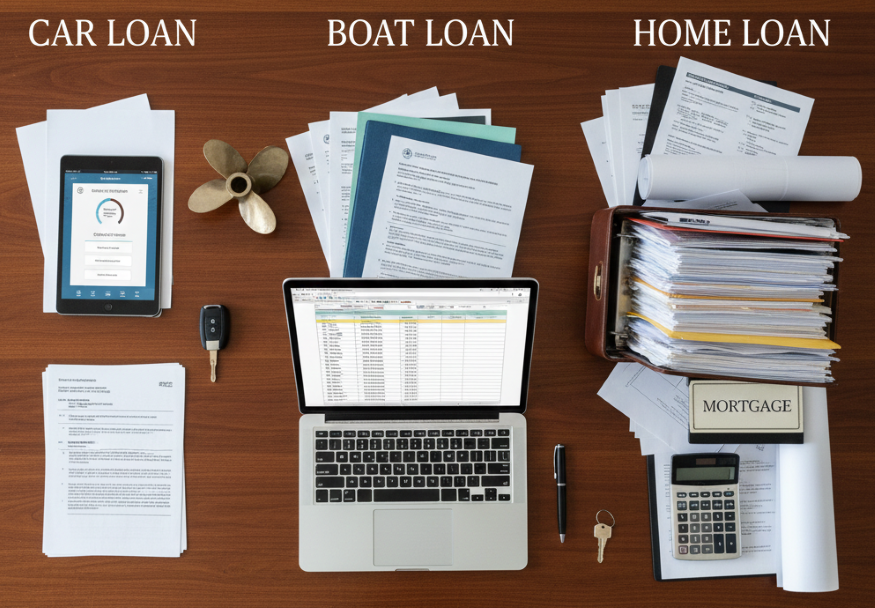
For many buyers, securing a boat loan is often their second or third experience financing a major asset, following an auto loan and a home mortgage. While the core concept—borrowing money and paying it back with interest—remains the same, marine financing is somewhat different.
Understanding the key differences between a boat loan, a car loan, and a home mortgage is important for setting expectations and navigating the approval process successfully.
Loan Term Length: The Yacht/Mortgage Hybrid
This is perhaps the most significant difference, setting boat loans apart from auto financing:
|
Loan Type |
Typical Term Length |
Why the Difference? |
|
Auto Loan |
3 to 7 years (36 to 84 months) |
Cars depreciate rapidly and have a shorter usable lifespan. |
|
Boat Loan |
10 to 20 years (120 to 240 months) |
Boats (especially quality vessels) depreciate slower than cars and are considered longer-term assets, justifying longer terms to keep payments affordable. |
|
Home Mortgage |
15 to 30 years (180 to 360 months) |
Homes are more stable assets that generally appreciate over time. |
The longer terms offered on boat loans (often up to 20 years for high-value vessels) provide for a more manageable payment, reflecting a structure more similar to a mortgage than a typical car loan.
Collateral and Asset Age
All three are secured loans, meaning the asset itself serves as collateral. However, the lending requirements surrounding the asset differ based on risk:
- Home Mortgage: The home's value is appraised, and an inspection is required. While older homes are common, their land and structural integrity are key.
- Auto Loan: The process is highly standardized due to the predictable depreciation of mass-market vehicles.
- Boat Loan: Because boats vary widely in construction, type (sailboat, yacht, cruiser), usage, and maintenance history, the collateral assessment is more rigorous:
- Marine Survey: For used boats, and sometimes for high-value new boats, a professional marine survey is required to verify the vessel's condition, safety, and market value. This is similar to a home appraisal/inspection.
- Age Limits: Many lenders have strict age limits, often only financing vessels up to 15 or 20 years old.
Interest Rates & Risk
Interest rates reflect the lender's perceived risk associated with the loan:
- Home Mortgage: Typically offers the lowest rates because real estate is considered one of the safest investments with a high likelihood of appreciation.
- Auto Loan: Rates are often lower than boat loans due to a shorter term, high sales volume, and the fact that a car is a necessity for many borrowers.
- Boat Loan: Rates generally trend higher than home loans. The reason being; a boat is a luxury/discretionary purchase. Lenders know that if a borrower faces financial stress, a boat payment is often the first thing cut. This higher risk is reflected in a higher rate.
Underwriting Scrutiny and Financial Requirements
Since a boat is a discretionary asset, the underwriting for a boat loan is often more stringent than for a standard car loan:
|
Requirement |
Auto Loan |
Boat Loan |
Home Mortgage |
|
Credit Score |
Standard (Often 670+) |
Higher (Often 700+ for best rates) |
High (Varies widely by program) |
|
Down Payment |
Often 0% to 10% (can be waived with promotions) |
Typically, 10% to 20% (often required) |
Varies (as low as 3.5% for FHA, 20% to avoid PMI) |
|
Liquidity |
Low to moderate focus |
High Focus (Lenders often look for significant liquid assets to cover payments in case of income interruption) |
High Focus |
|
Required Docs |
Simple (Pay stubs, credit report) |
More complex (Tax returns, asset statements, Marine Survey) |
Very complex (Tax returns, employment verification, etc.) |
Potential Tax Deductibility
One major similarity boat loans does share with home mortgages (and not auto loans) is the potential for a tax deduction:
- Boat Loan Interest may be tax-deductible if the boat qualifies as a second home. To qualify, the boat must have a galley (kitchen), a head (toilet), and sleeping quarters. This deduction makes the long-term cost of a boat loan significantly more attractive.
A boat loan is a highly specialized product that marries the long term and high scrutiny of a mortgage with the asset-backed collateral of an auto loan.
Marine financing may be a niche category, but it doesn’t have to feel complicated. With a clear sense of what lenders look for—and how boat underwriting fits between autos and homes—you can approach the process confidently and move one step closer to casting off on your next adventure.
